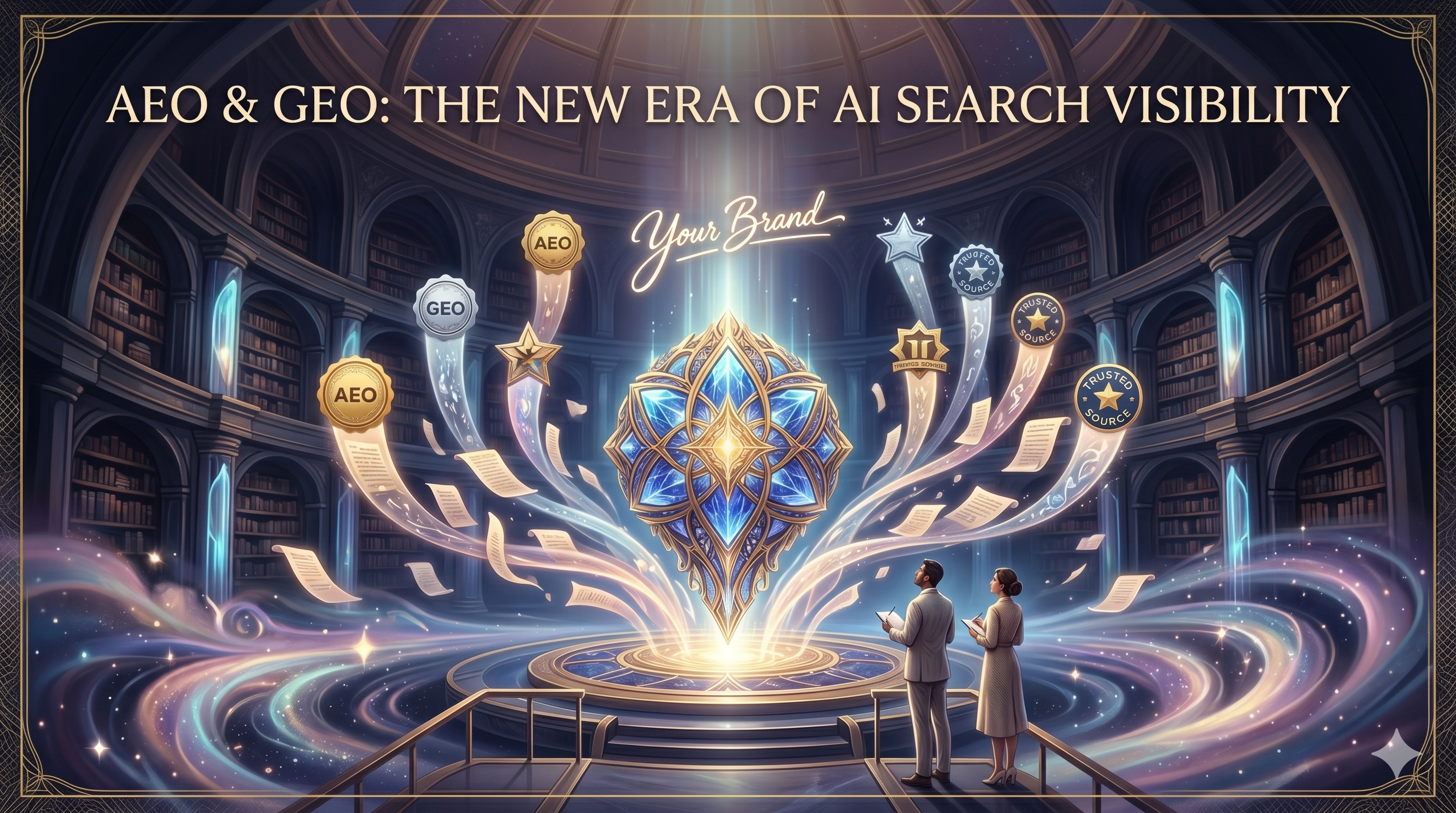
Citations in AEO and GEO are mentions, references, or attributions of your brand by AI search engines like ChatGPT, Perplexity, Gemini, and Google AI Overviews in their generated responses. They function as the AI equivalent of search rankings. Brands that earn consistent citations across AI platforms gain visibility that traditional SEO alone cannot deliver. This guide covers what AEO and GEO citations are, how AI engines decide which sources to cite, the seven types of citations that drive AI visibility, and a step-by-step strategy for building citation authority.
Key Takeaways on AEO and GEO Citations
AI engines cite brands with strong entity signals across Wikipedia, Wikidata, G2, Crunchbase, and industry directories.
Structured FAQ blocks and comparison tables are extracted by AI engines at a significantly higher rate than unstructured narrative prose.
Roundup and listicle articles are among the most frequently cited source types in AI-generated responses, according to research from HeyMilo and SocialTalent published in 2026.
E-E-A-T signals including author credentials, publication dates, and original data directly influence whether AI engines trust content enough to cite it.
External citation signals from guest posts, podcast appearances, review platforms, and media mentions compound over time and increase AI citation probability across every platform.
A brand with zero presence on review platforms like G2, Capterra, and Clutch loses comparison citation opportunities to every competitor that maintains active profiles on those platforms.
Building AEO and GEO citation authority typically takes three to six months of focused effort before initial citations begin appearing, with twelve months of consistent work producing meaningful citation share against competitors.
What Are AEO and GEO Citations and How They Differ from Traditional SEO Citations?
In traditional local SEO, the word citation refers to a mention of a business name, address, and phone number across online directories. Local SEO professionals have used citation building as a core ranking tactic for years, and that practice still matters for location-based search visibility.
In AEO and GEO, the meaning of a citation is broader and carries greater consequences for brand visibility in the AI-driven search landscape.
An AEO or GEO citation is any mention, reference, or attribution of your brand, content, data, or expertise by an AI engine in its generated response. When someone asks ChatGPT which CRM platforms work best for mid-sized companies and the response names your product alongside Salesforce and HubSpot, that is a citation. When Perplexity answers a question about your industry and includes a numbered link to your blog post as a supporting source, that is a citation. When Google AI Overviews pulls a definition from your website and displays it above the traditional search results, that is a citation.
The critical difference between a traditional backlink and an AI citation comes down to who makes the decision to include your brand. A backlink is placed by a human author who chose to reference your content. An AI citation is generated by a language model that evaluated thousands of potential sources and determined yours was the most relevant, credible, and extractable option for a specific query. The evaluation criteria are different, the signals the AI evaluates are different, and the strategy required to earn citations consistently is fundamentally different from the strategy that earns backlinks.
According to Google’s own documentation on AI Overviews, the system is designed to synthesise information from multiple high-quality sources and present it in a way that directly answers the user’s question. Being among those selected sources is what AEO and GEO citation strategy is built around.
Citations in AEO and GEO function as the AI search equivalent of rankings. In traditional search, brands compete for positions on a results page. In AI search, a brand is either cited in the generated answer or it is entirely absent. There is no second page, no position seven, and no partial visibility. The binary nature of AI citations makes them harder to earn and significantly more valuable once earned.
Why AEO and GEO Citation Authority Has Become the Most Important Visibility Signal
The shift in how people research products, services, and information is accelerating faster than most marketing teams have acknowledged internally.
Google AI Overviews now appear on roughly 60 percent of search queries, according to analysis from SE Ranking and BrightEdge published in early 2026. These overviews deliver synthesised answers before the user encounters a single traditional result. The click-through rate on organic results drops significantly when an AI Overview occupies the top of the page, because the buyer often gets what they need without scrolling further.
ChatGPT processes hundreds of millions of queries daily, and a meaningful portion of those queries are the same product research, comparison, and recommendation questions that buyers used to type into Google. Perplexity has positioned itself as the research engine for professionals who want sourced, cited answers delivered in a structured format. Gemini integrates directly into Google’s ecosystem and influences how information is surfaced across Gmail, Google Docs, and Google Search.
In each of these environments, the AI engine reads across thousands of pages, synthesises the information, and presents an answer that names specific brands, links to specific sources, and attributes specific claims to specific content. Those named references are citations. Every buyer who asks a similar question sees those same citations. Unlike a blog post that requires the reader to discover it through a search query, an AI citation is delivered directly inside the answer. The distribution is built into the format itself.
The compounding effect of AI citations makes them particularly powerful over time. When ChatGPT cites a brand in a response, every subsequent user who asks a related question has a chance of seeing that same citation. When Perplexity links to a piece of content as a source, every professional who uses Perplexity for research in that category encounters the brand. When Google AI Overviews pulls from a page, every searcher who triggers that overview sees the content before anything else on the results page.
Citations also create a reinforcement loop across AI engines. When multiple independent AI platforms cite the same brand for the same topic, each platform’s citation reinforces the others. A brand that is consistently cited by ChatGPT, Perplexity, and Gemini simultaneously builds a compounding authority advantage that becomes progressively more difficult for competitors to displace. This cross-platform reinforcement is one of the strongest moats in modern digital marketing.
How AI Search Engines Decide Which Sources to Cite in Their Responses
The selection process AI engines use to choose their citation sources differs from traditional search algorithms in several fundamental ways. Understanding these differences is what separates an effective AEO and GEO strategy from guesswork.
How Entity Recognition Determines Whether AI Engines Trust Your Brand
AI engines do not evaluate individual pages in isolation the way traditional search crawlers do. They evaluate entities. An entity is the AI’s consolidated understanding of who you are as a brand, a person, or an organisation across the entire web.
The stronger and more consistent your entity signals are across authoritative platforms, the more confidently an AI engine will recognise and cite you. Entity signals include consistent brand mentions across platforms like Wikipedia, Wikidata, Crunchbase, G2, Clutch, LinkedIn, and industry-specific directories. They include founder and team mentions in publications, podcasts, and industry events. They include structured data markup on your website that explicitly communicates who you are, what you do, and how you relate to other entities in your space.
Google’s Knowledge Graph documentation confirms that structured data helps search systems understand the relationships between entities on the web. AI engines built on top of these systems inherit the same entity associations. A brand with a well-connected Knowledge Graph presence has a significant citation advantage over a brand that exists only on its own website.
A brand with weak or inconsistent entity signals is essentially unrecognisable to AI engines. Even excellent content will be overlooked if the AI has no confidence in the identity of the source. Entity strength is the prerequisite that everything else builds upon.
Why Structured Content Gets Cited More Often Than Narrative Prose
AI engines favour content that is easy to parse, extract, and include in a generated response. This is a fundamentally different optimisation target than traditional SEO, where content depth, word count, and comprehensive coverage often correlated with higher rankings.
Content that earns AI citations consistently shares several structural qualities. It opens with a clear, concise definition or answer within the first 100 to 150 words. It organises supporting detail under descriptive headings that mirror how buyers phrase their questions. It includes structured FAQ blocks where each answer is complete enough to stand alone without surrounding context. It uses comparison tables, numbered processes, and data-backed claims that the AI can extract as discrete units of information.
Research from Princeton’s Generative Engine Optimization study (2024) confirmed that content optimised with structured citations, statistics, and quotations from authoritative sources appeared in AI-generated responses at significantly higher rates than unoptimised content covering the same topics.
The reason structure carries so much weight in AI citation decisions is that language models parse content for extractable information units rather than reading it linearly the way a human reader would. A 3,000-word article with beautiful narrative prose and no structural markers will consistently lose citation opportunities to a 1,500-word article with clear headings, FAQ blocks, and comparison tables. The shorter, more structured article is easier for the AI to use, and AI engines will always prefer the source that requires the least interpretive effort.
How E-E-A-T Signals Influence AI Citation Trust and Source Selection
Experience, Expertise, Authoritativeness, and Trustworthiness have mattered for Google rankings since the concept was introduced in Google’s Search Quality Evaluator Guidelines. For AI citations, these signals carry even greater weight because the AI engine is effectively endorsing the source by including it in a response. The AI is staking its own credibility on the quality of every source it cites.
E-E-A-T signals that directly influence AI citation decisions include author bios with verifiable professional credentials, publication dates that confirm the content is current, references to primary sources within the content, original data or research that cannot be found on other sites, and clear affiliation with recognised organisations or institutions.
Generic content written by unnamed authors with no credentials, no publication dates, and no original data occupies the lowest tier of citation probability. The AI has no basis for trusting that content when more credible alternatives are available across the web. Every piece of content that lacks these trust signals is competing at a severe disadvantage.
How Cross-Web Citation Frequency Shapes AI Source Preferences
AI engines are trained on data from across the entire web. When your brand, your content, or your original data is referenced by multiple independent sources, the AI develops a stronger association between your brand and the topic in question.
This is why digital PR, guest posting on authoritative publications, podcast appearances with published transcripts, and industry event participation all feed directly into AEO and GEO visibility. Each external mention creates a data point that reinforces the AI’s understanding of your relevance and authority on a given subject.
A study published by Moz in 2025 on brand authority signals confirmed that brands mentioned across a diverse range of authoritative sources received disproportionately higher visibility in AI-generated responses compared to brands with equivalent or stronger on-site content but fewer external mentions.
A brand that is mentioned in five industry publications, three comparison articles, two podcast transcripts, and one Wikipedia reference will almost always be cited ahead of a brand that has a technically perfect website with zero external footprint. AI engines evaluate the entire web when making citation decisions, and your website is only one signal among thousands.
Why Content Freshness and Recency Impact AEO and GEO Citation Rankings
AI engines prioritise recent information, particularly for queries about evolving topics, product comparisons, technology trends, and industry developments. Content published in 2023 about a topic that has changed materially since then is unlikely to earn citations when newer, more accurate alternatives exist.
Maintaining content freshness through regular updates, current publication dates, and recent data points is a baseline requirement for sustained citation visibility. A brand that published a comprehensive guide two years ago and never revisited it will gradually lose citation share to competitors who update their content quarterly or publish new pieces more frequently.
The freshness signal is particularly strong for queries that contain implicit recency markers. When a buyer asks “best AI hiring tools” the AI engine assumes they mean the best tools available right now. Content dated 2024 or earlier carries a meaningful disadvantage against content published in 2026, even if the older content is more comprehensive in scope.
Seven Types of AEO and GEO Citations That Drive AI Search Visibility
Understanding the different types of citations helps prioritise where to invest effort and which content formats to create. Here is a comparison of all seven types:
| Citation Type | What It Looks Like | How to Earn It | Best Content Format |
|---|---|---|---|
| Direct Brand Citation | AI names your brand in the response body | Strong entity signals across web platforms | Brand pages, review profiles, Wikipedia |
| Content Source Citation | AI links to your content as a reference | Structured, extractable content with original insights | Guides, how-to articles, FAQ pages |
| Expert Citation | AI quotes a person from your organisation | Founder visibility through publications and podcasts | Bylined articles, interviews, talks |
| Data and Research Citation | AI references a specific statistic from your content | Original research, surveys, case studies with real numbers | Research reports, data studies, annual reports |
| Definition and Framework Citation | AI uses your definition or methodology | Coined terminology promoted consistently across channels | Framework pages, methodology explainers |
| Comparison and Alternative Citation | AI includes your brand in a comparison list | Presence on G2, Capterra, roundup articles | Review profiles, comparison content |
| Local and Directory Citation | AI includes your brand for geographically scoped queries | Consistent NAP, optimised GBP, local content | Location pages, GBP, local directories |
Each citation type serves a different function in the buyer journey. Direct brand citations and comparison citations are most valuable for bottom-funnel queries where buyers are making decisions. Content source citations and data citations build mid-funnel authority. Definition citations and expert citations establish long-term category ownership.
How Direct Brand Citations Work in AI Search Responses
Direct brand citations are the most valuable type. The AI engine mentions your brand by name in the body of its generated response. When a buyer asks “what project management tools work well for small teams” and the AI responds with a list that includes your product name, you have earned a direct brand citation.
Direct brand citations require the strongest entity signals of any citation type. The AI needs to be confident that your brand is a legitimate, recognised player in the category before it will name you alongside established competitors. Building this confidence requires consistent brand presence across review platforms, industry directories, media mentions, and authoritative reference sources. A brand that exists only on its own website will struggle to earn direct citations regardless of content quality.
How Content Source Citations Drive Referral Traffic from AI Engines
Content source citations occur when the AI engine extracts information from your content and attributes it to you as the source. Perplexity displays these most visibly by including numbered links alongside its generated answers. Google AI Overviews also display source links below the synthesised response. These citations are the primary driver of referral traffic from AI engines because they include a clickable link.
Earning content source citations requires structured, extractable content that contains original insights, unique data points, or definitive answers that the AI cannot find assembled in the same way on other sites. The content has to offer something the AI considers worth attributing to a specific source rather than synthesising anonymously from general knowledge.
How Expert Citations Build Personal and Brand Authority in AI Responses
Expert citations occur when the AI engine references a specific person from your organisation as an authority on a topic. A response that includes phrasing like “according to [name], CEO of [company], the key consideration is…” represents an expert citation that carries significant trust value for both the individual and the brand.
Earning expert citations requires individual visibility for founders and senior team members. Published articles under their name, podcast appearances, conference presentations, and quoted commentary in industry publications all create the signals AI engines need to associate a person with a topic and cite them as an authority. According to LinkedIn’s own research on thought leadership, 65 percent of B2B buyers say thought leadership content significantly changes their perception of a company.
How Data and Research Citations Establish Category Authority
Data citations occur when an AI engine references a specific statistic, research finding, or numerical claim from your content. A response that states “according to a study by [your brand], 73% of enterprises have yet to address their data governance architecture” represents a data citation that is both specific and attributable.
Earning data citations requires publishing original research, surveys, case studies with real performance numbers, and industry reports that contain unique, verifiable statistics. AI engines prioritise original data because it adds specificity and credibility to their responses in ways that generic claims and opinions cannot match.
How Definition and Framework Citations Create Lasting Category Ownership
Definition citations occur when an AI engine uses your specific definition of a concept or your proprietary framework for approaching a problem. If you coined a term, created a methodology, or defined a concept in a way that the AI adopts and attributes to you, that is a definition citation.
These are among the most durable citation types. Once an AI learns to attribute a concept to a specific source, that attribution tends to persist across subsequent responses. Earning definition citations requires creating original terminology, frameworks, or methodologies and promoting them consistently across your content, social channels, and external publications until the AI begins associating the concept with your brand.
How Comparison and Alternative Citations Capture Bottom-Funnel Buyer Queries
Comparison citations occur when an AI engine includes your brand in a list of alternatives or a competitive comparison. A response to “what are good alternatives to HubSpot” that includes your brand represents a comparison citation that reaches the buyer at the moment of decision.
These citations carry the highest conversion potential because they appear in responses to bottom-funnel queries where buyers are actively evaluating options. Earning them requires active profiles on review platforms like G2 and Capterra, presence in third-party comparison and roundup articles, and published comparison content on your own site that positions your brand alongside recognised competitors.
How Local and Directory Citations Influence Geographically Scoped AI Responses
For businesses with a physical presence or geographic relevance, local citations from Google Business Profile, industry directories, and location-specific platforms feed into AI engines’ understanding of relevance for geographically scoped queries.
A buyer asking “best marketing agency in Bangalore” triggers a geographically scoped AI response that draws heavily from local citation signals. Consistent NAP (Name, Address, Phone) across directories, an optimised Google Business Profile, active review collection, and location-specific website content all contribute to earning local citations in AI-generated responses.
Step-by-Step AEO and GEO Citation Building Strategy for 2026
Building citation authority requires a systematic programme across multiple fronts. Here is the sequence that produces the fastest and most sustainable results.
Step 1: Build and Strengthen Entity Signals Across Authoritative Platforms
Start with an entity audit. Check your brand’s presence across Crunchbase, Wikidata, G2, Capterra, Clutch, LinkedIn Company Page, Google Business Profile, and every industry-specific directory relevant to your category. Create profiles where they are missing and update existing ones to ensure consistent naming, descriptions, and categorisation across every platform.
If your brand qualifies for a Wikipedia page, pursue it as a high priority. Wikipedia is one of the most heavily weighted sources in AI training data according to research published by both OpenAI and Google DeepMind. A single Wikipedia reference carries more citation influence than hundreds of blog backlinks. Even a mention within a related Wikipedia article adds meaningful entity signal.
Implement structured data markup across your entire website. Organization schema on the homepage, Person schema for founders and key team members, Product or Service schema for offerings, and Article schema on every blog post. These markup implementations communicate your identity to AI engines in a machine-readable format that removes the ambiguity language models encounter when processing unstructured text.
Step 2: Create Structured, Extractable Content Optimised for AI Citation
Audit your existing content library and identify the pages most likely to match buyer-intent queries in AI search. Restructure those pages with AI extractability as a primary design goal alongside traditional readability.
Every important page should open with a clear, concise answer within the first 150 words. This opening section is what AI engines most frequently extract for their responses. A study by Surfer SEO on AI Overview source analysis found that cited sources almost universally provided a direct, structured answer within the opening paragraphs of the page.
Follow the opening answer with structured detail under descriptive H2 and H3 headings that contain your target keywords and match how buyers phrase their questions in natural language.
Add FAQ blocks to every commercial and educational page. Write each FAQ answer as a complete, standalone response that makes sense without surrounding context. Implement FAQPage schema on every page that contains these blocks so AI engines can identify and extract the Q&A pairs programmatically rather than through visual interpretation.
Create comparison tables wherever the content involves evaluating multiple options, features, or approaches. AI engines extract tabular data frequently because it is structured, concise, and easy to incorporate directly into generated responses without requiring reformatting.
Embed original data points, case study numbers, and verifiable statistics throughout your content. Label your own original data clearly and cite external sources when referencing third-party data. AI engines prioritise content that offers unique, specific information over content that repackages commonly available knowledge from other sources.
Step 3: Build External Citation Signals Through PR, Guest Posts, and Industry Media
Internal content optimisation covers half of the citation equation. The other half is building the external signal network that tells AI engines your brand is recognised and referenced by independent sources across the web.
Pursue guest posting on authoritative publications in your industry. Each bylined article published on an external platform creates a citation signal that reinforces the AI’s understanding of your expertise. Aim for publications with genuine editorial standards and real readership. Avoid link farm sites and low-quality guest post networks that add no citation value.
Respond to journalist queries through platforms like HARO (now Connectively), Qwoted, and Help a B2B Writer. Each quoted mention in a publication creates an expert citation signal that associates your name and brand with specific topics. Aim for three to five responses per week to maintain a steady flow of expert mentions across the web.
Publish original research reports, data studies, and survey findings that other publications will naturally reference and link to. When your data appears in independent sources, the AI builds a stronger association between your brand and authoritative information on that topic. Original data is one of the highest-leverage citation signals because it cannot be replicated by competitors.
Accept podcast invitations and participate in webinars where transcripts are published online. AI engines process transcript text and create associations between speakers and the topics they discuss. A founder who appears on five industry podcasts creates five independent citation signals that compound over time.
Step 4: Get Featured in Roundup and Listicle Articles That AI Engines Cite
Roundup articles and listicles are among the most frequently cited source types in AI-generated responses. Articles titled “Top 10 AI Hiring Tools in 2026” or “Best CRM Platforms for Enterprise” appear in AI answers at a disproportionately high rate because they provide pre-structured, comparative information that AI engines can synthesise directly without significant reformatting.
An analysis of AI Overview sources by Ahrefs in 2025 found that list-format and comparison-format articles were cited at roughly twice the rate of standard editorial content for product and service-related queries.
Identify every roundup article published in the last 12 months that covers your product category. Determine which publications accept editorial submissions, sponsored inclusions, or update requests. Submit your brand with a clear pitch that explains why it belongs on the list and what differentiates it from existing entries.
Target five to ten live roundup placements within the first 90 days of your AEO programme. Each placement meaningfully increases the probability that AI engines will include your brand when generating comparison or recommendation responses for your category.
Step 5: Build Active Review Platform Presence for Comparison Citation Signals
Review platforms like G2, Capterra, Clutch, and Google Business Profile are heavily weighted in AI training data. When a buyer asks an AI engine to compare products in a specific category, the AI frequently draws from review platform data to inform its response and support its recommendations.
G2 publishes quarterly grid reports that rank products by satisfaction and market presence. These reports are frequently cited by AI engines as supporting evidence for product recommendations. Capterra’s comparison pages serve a similar function for different buyer segments.
Set up verified profiles on every major review platform relevant to your category. Build a systematic review collection programme targeting your most satisfied clients. Three to five verified reviews per platform is enough to establish initial presence. Ten or more reviews with consistent high ratings begins to influence AI citation decisions in a measurable way.
Display review badges and ratings on your website to create a visual trust signal for human visitors and a structured data signal for AI crawlers that process your pages.
Step 6: Develop Founder and Team Visibility for Expert Citation Signals in AI Search
AI engines weight individual expertise alongside brand authority when making citation decisions. A brand with visible, credible founders and team members earns expert citations that a faceless brand simply cannot access regardless of content quality.
Build the founder’s LinkedIn presence through consistent publishing on topics directly tied to the brand’s category. Three to four posts per week in the founder’s authentic voice, covering real decisions, real problems, and real outcomes from their work. Ensure the LinkedIn profile is set to public visibility so that search engines and AI crawlers can index the content and associate it with the brand entity.
Publish bylined articles under the founder’s name on industry publications. Create a dedicated author page on the company website that lists professional credentials, published work, speaking engagements, and media appearances. Implement Person schema for key team members so AI engines can programmatically connect the individual to the brand entity.
The goal is to create a web of associations between the person, the brand, and the topic category so that AI engines recognise the individual as an authority worth citing by name.
Step 7: Monitor and Measure AEO and GEO Citation Performance on a Monthly Basis
Measurement in AEO and GEO is still maturing as a discipline, but practical approaches are available today and improving rapidly.
Maintain a fixed set of 30 to 50 buyer-intent prompts relevant to your category. Run them monthly across ChatGPT, Perplexity, Gemini, and Google AI Overviews. Record whether your brand is cited in each response, how the citation is framed, what competitors appear alongside you, and which specific sources the AI links to when providing references.
Use emerging tracking tools like Otterly, Profound, AthenaHQ, or SE Ranking’s AI visibility module to automate portions of this monitoring process. These tools track brand mentions and citation share across AI engines on a scheduled basis and surface trends over time.
Monitor referral traffic from AI engines in GA4. ChatGPT, Perplexity, and other AI platforms are beginning to appear in referral traffic data, providing a partial but growing picture of which engines are actively sending users to your site based on citations.
Track unlinked brand mentions across the web using tools like Mention, Brand24, or Ahrefs Content Explorer. Each unlinked mention is a potential citation signal that feeds into AI training data and contributes to your brand’s entity strength.
Build a monthly citation report that tracks your citation share against the top three to five competitors in your category. Over time, this report becomes the primary performance indicator for whether your AEO and GEO programme is producing measurable results.
Common AEO and GEO Citation Mistakes That Destroy AI Search Visibility
Several common practices actively prevent AI engines from citing a brand, and most marketing teams continue making these mistakes without realising the impact.
Publishing content without clear author attribution is one of the most damaging habits in AEO and GEO. AI engines cannot assign expert credibility to content that has no named author with verifiable credentials. Every blog post, guide, and article should carry a visible author bio with professional background, relevant expertise, and links to the author’s published work elsewhere on the web.
Writing long, unstructured content without extractable sections is equally harmful to citation probability. AI engines skip content they cannot parse efficiently. If a page has no clear answer in the opening paragraphs, no FAQ blocks, no structured headings with target keywords, and no comparison tables, it is functionally invisible to AI extraction processes regardless of how comprehensive the information is.
Maintaining inconsistent brand information across platforms creates entity confusion that directly undermines citation probability. If your brand is described differently on LinkedIn, G2, Crunchbase, and your website, the AI engine cannot confidently associate those signals with a single entity. Consistency across every platform is a baseline requirement for entity recognition.
Ignoring review platforms entirely removes one of the strongest citation signal sources available. G2, Capterra, Clutch, and Google reviews are heavily weighted in AI training data. A brand with zero reviews on these platforms loses comparison and alternative citation opportunities to every competitor that maintains active profiles.
Publishing content once and leaving it untouched causes citation decay over time as AI engines favour newer, more current alternatives. A comprehensive guide published two years ago that has never received an update will gradually lose citation share to competitors who refresh their content regularly with current data and updated perspectives.
Building a strong website without any external presence severely limits citation probability. AI engines evaluate signals from across the entire web when selecting citation sources. A brand that produces excellent content on its own domain but has zero media mentions, zero review platform presence, and zero guest publications is far less likely to be cited than a competitor with moderate website content and strong external signals.
How AEO and GEO Citations Work Together with Traditional SEO Rankings
Traditional SEO and AEO/GEO citation building are complementary strategies that reinforce each other when executed as a unified programme.
Strong traditional SEO creates the content foundation that AI engines evaluate when considering potential citation sources. Technical health, content quality, domain authority, and page experience all influence whether an AI engine considers a source credible enough to cite. A website with poor Core Web Vitals, thin content, and minimal backlinks is unlikely to earn AI citations regardless of how well the content is structured for extraction.
AEO and GEO build on that traditional foundation by optimising content structure for AI extractability, strengthening entity signals beyond the website itself, and developing the external citation network that gives AI engines confidence in the brand’s authority and relevance.
The most effective approach treats every piece of content as serving both audiences simultaneously. Structure content with clear headings, FAQ blocks, and comparison tables so AI engines can extract what they need efficiently. Write with depth, nuance, and genuine expertise so human readers find real value and spend time on the page. Build backlinks for traditional domain authority and pursue external mentions for AI citation signals.
Brands that invest in both layers at the same time will compound their visibility faster than brands that focus on one layer exclusively. The future of search visibility is built on traditional rankings and AI citations working together as a unified strategy. Treating them as separate programmes leaves significant growth on the table.